
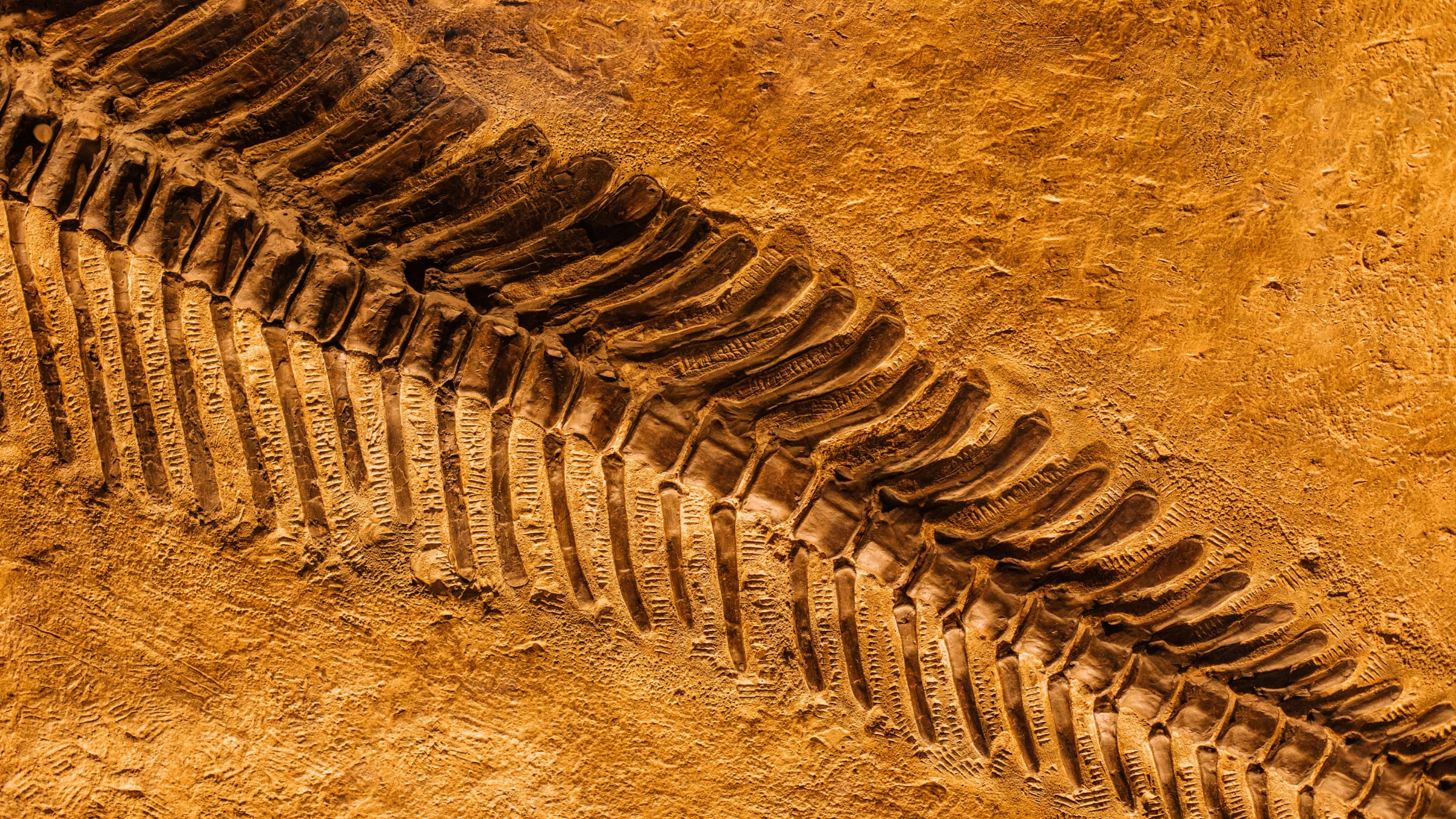
Dinosaur relevance to fitness
My Son, Gunnar, is five and lately everything in our house is a fossil.
Rocks from the yard become “discoveries.” The simulated sandbox is a dig site. One afternoon, he held up a broken stick and told me, completely serious, “This used to be a dinosaur leg.”
I asked him how he knew.
He said, “You just have to figure out the rest.”
That stopped me in my tracks.
Because that’s exactly what we do in training and rehab.
We don’t get the whole picture either. We see tight hips, poor posture, a movement that doesn’t look right—just fragments. And like a young Paleontologist, we start asking questions. What was this supposed to look like? How did it move when it worked right?
Gunnar doesn’t see a broken stick. He sees a complete dinosaur waiting to be rebuilt.
And that’s the job—whether you’re studying ancient life or helping someone move without pain.
Piece by piece, restoring structure…until the whole system comes back to life.
At first glance, Paleontology and personal fitness/rehab seem worlds apart—but structurally, they operate on strikingly similar principles: reconstruction, pattern recognition, and progression from incomplete systems.
The following is a grounded comparison:
1. Fragment → Whole System Understanding
Paleontology:
Works from fragments—bones, imprints, chemical traces—to reconstruct entire organisms and ecosystems.
Fitness & Rehab:
Works from symptoms, imbalances, movement dysfunctions to reconstruct full human function.
Parallel:
Both fields infer the whole from incomplete data.
- Fossilized femur → gait, posture, behavior
- Tight hip flexor → compensation patterns, spinal load, breathing mechanics
2. Structure Dictates Function
Paleontology:
Bone structure reveals how an organism moved, hunted, or survived.
Fitness/Rehab:
Joint alignment, muscle balance, and tissue quality dictate movement capacity.
Parallel:
- A misaligned skeleton = inefficient or impossible movement
- A misaligned human system = pain, compensation, injury
This aligns directly with our neutral biomechanics model—structure first, then performance.
3. Adaptation Over Time
Paleontology (via evolution):
Tracks how organisms adapt across generations to environmental stressors.
Fitness/Rehab:
Tracks how individuals adapt within a lifetime to applied stress (training or injury).
Parallel:
- Evolution = long-term progressive overload
- Training = short-term evolution
Poor adaptation → extinction / injury
Optimal adaptation → survival / performance
4. Environment Shapes Outcomes
Paleontology:
Climate, terrain, predators, and food sources shape anatomy.
Fitness/Rehab:
Lifestyle (HNARE), habits, ergonomics, sleep, and stress shape physiology.
Parallel:
You don’t fix the organism without addressing the environmental pressures.
- Dinosaur in swamp → wide stance, stability adaptations
- Human at desk 10 hrs/day → forward head, tight hips, inhibited glutes
5. Return to Baseline (Neutral)
Paleontology:
Seeks to understand the organism’s natural resting structure—how it stood, moved, and balanced in its environment.
Fitness/Rehab:
Seeks to restore neutral alignment and tension balance.
Parallel:
Your concept of:
- Neutrality
- Return to baseline between efforts
…is essentially reconstructing the organism’s default state of efficiency—just like paleontologists reconstruct a dinosaur’s natural posture.
6. Error Margin & Assumptions
Paleontology:
Always has uncertainty—soft tissue, behavior, coloration often inferred.
Fitness/Rehab:
Also deals with uncertainty—pain perception, neuromuscular patterns, compliance.
Parallel:
Both require:
- Hypothesis → Test → Adjust
- Continuous refinement
7. Time Scale Difference (Key Contrast)
Paleontology:
- Millions of years
- Population-level change
Fitness/Rehab:
- Days to months (rehab)
- Weeks to years (performance)
- Individual-level change
Insight:
Fitness is essentially compressed evolution under controlled conditions.
8. Death vs Dysfunction (Stakes)
Paleontology:
Failure = extinction
Fitness/Rehab:
Failure = pain, degeneration, reduced quality of life
Same principles—different stakes and timelines.
Bottom Line
Paleontology studies how organisms became functional over time.
Fitness and rehab determine how a human returns to or improves function in real time.
Clean analogy:
Paleontology is the study of how structure created survival
Fitness/Rehab is the practice of restoring structure to enable survival and performance